Journalists and press freedom advocates have criticised the use of criminal defamation and cybercrime laws to intimidate and prosecute journalists for asking questions and doing their jobs.
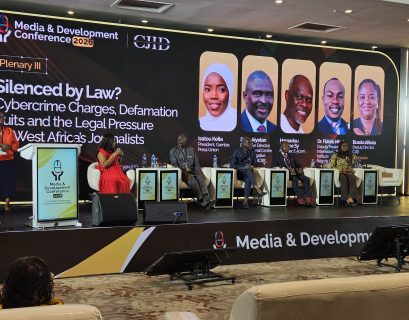
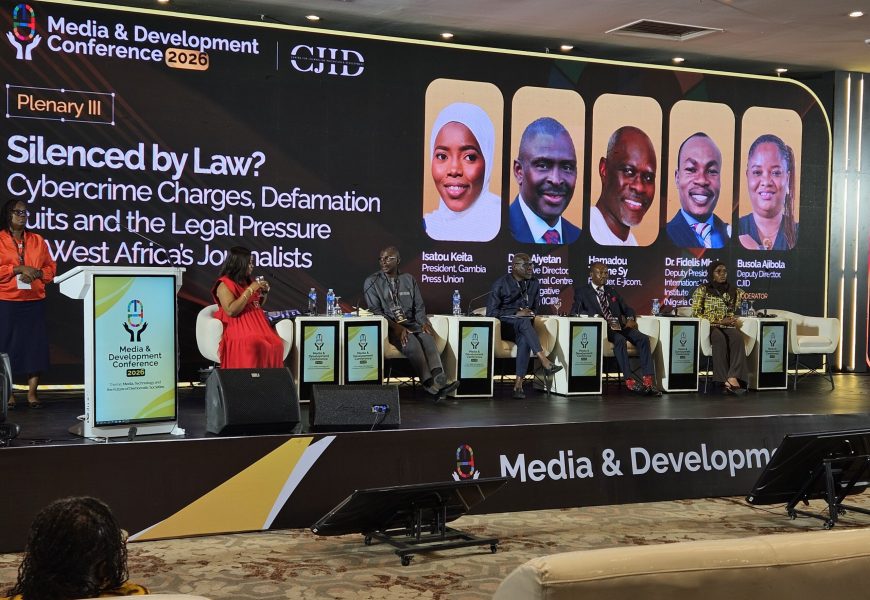
During a panel session at the Media and Development Conference (MDC 2026) on Monday, media leaders from different West African countries shared experiences of legal pressure against journalists. They called for stronger collective action to protect press freedom.
The session, titled “Silenced by Law? Cybercrime Defamation Suits and the Legal Pressure Against West Africa’s Journalists”, was moderated by Busola Ajibola, deputy director of the Centre for Journalism Innovation and Development (CJID).
Mrs Ajibola opened the discussion by urging participants to support journalists who speak out on behalf of others, often at great personal cost.
“To have somebody who is speaking courageously on behalf of millions and millions of people, putting everything that they have on the line, it can clearly be a very lonely journey, I tell you,” she said.
“Again, I’m calling on you, all of you in the room, at least to press this gospel, that we all have to stand together and make sure that we support journalists, and that we are all in the same boat.”
The MDC is a three-day event that brings together journalists, policymakers, researchers, technology companies, civil society leaders and development institutions from across Africa to examine challenges facing journalism and democratic governance in a rapidly changing technological environment. The fourth edition of the annual conference is themed “Media, Technology and the Future of Democratic Societies”.
Earlier during the conference, Mrs Ajibola had led participants in solidarity with West African journalists being persecuted for their work.
The journalists include Nigeria’s Daniel Ojukwu, Nigerien Moussa Kaka and Burkina Faso’s Serge Oulon.
Mr Ojukwu was recently remanded in prison in a criminal defamation case filed against him by the Nigerian Police Force (NPF) over a series of stories he wrote in 2023 about Adejoke Orelope-Adefulire, the senior special assistant on sustainable development goals (SSAP-SDGs) to former President Muhammadu Buhari. He was charged under the Cybercrimes Act, which the government has infamously used to hound critics and journalists.
Calls for legal reforms
Fidelis Mbah, deputy president of the International Press Institute (IPI), Nigeria chapter, said the vague wording of the laws allowed authorities to abuse them and target journalists.
“The framing is so bogus that it gives room for anybody to exploit,” he said.
Mr Mbah, who said he had also been arrested, recounted the case of a journalist who was arrested over a report about a bank, which he described as factual.
Mr Mbah said the IPI has continued to pressure authorities to release detained journalists and challenge cases of alleged persecution in court, adding one of the cases was still pending in court.
Asked how the media could get the police and anti-corruption agencies to act on the findings of investigative reports, Dayo Aiyetan, executive director of the International Centre for Investigative Reporting (ICIR), said journalists could not rely on the agencies.
Mr Aiyetan said he had little confidence that the agencies would act on journalists’ investigations, despite reports highlighting billions of naira in public funds allegedly not properly expended.
He specifically criticised the Economic and Financial Crimes Commission (EFCC) for failing to act on such reports.
“We are talking about public funds,” he said. “And the media has listed billions of naira of public funds that may not have been judiciously expended. But the anti-corruption agency is not interested, even after we have called their attention to it. So what are we talking about?”
He also criticised the use of public resources to defend individuals who sue journalists for defamation over reports holding them accountable.
Responding to a question from Ms Ajibola on what regional advocacy for repealing criminal defamation laws should look like, Mr Aiyetan said he had written a report examining cybercrime laws in four African countries.
He said the report identified similar problems across the countries and urged media unions and advocacy groups to work together to push for legal reforms.
“Government must never regulate the media”
On media regulation, Isatou Keita, president of the Gambia Press Union, maintained that the government must never be allowed to regulate the media.
Ms Keita said journalists in her country had rejected a government proposal to regulate who could practise journalism in The Gambia.
She said the Ministry of Information had initiated a process to introduce rules governing the profession, including a requirement for journalists to register.
“Everybody wants to be regulated,” she said. “But it can never be done by the government.”
She said the media already had a self-regulatory body, the Media Council of The Gambia, and that the union had refused to participate in the ministry’s process.
READ ALSO: EFCC, Australian police sign MoU to tackle cybercrime
She said the union also urged journalists across the country to remain united, warning that division within the media would work to the government’s advantage.
According to her, government officials had also warned that media organisations that refused to cover government events could lose funding.
She said the registration requirement was subsequently removed from the draft document.
Ms Keita added that a meeting held last Friday between the press union, the Gambia Bar Association and the ministry agreed that experts should review the document and recommend a way forward.
“We are not against regulation, but we have our own media council,” she said.
Discover more from Premium Times Nigeria
Subscribe to get the latest posts sent to your email.