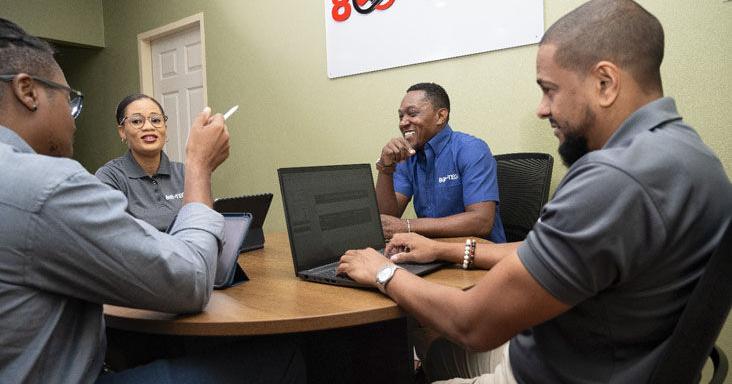
For 800-TECH Ltd managing director Scofield Thomas, cybersecurity is no longer simply an IT (information technology) issue. It is a business continuity and leadership issue.
The local technology company has evolved from a traditional “break-fix” IT provider into a managed services company, with cybersecurity now at the centre of its strategy as businesses become increasingly dependent on technology and face growing cyber risks.
‘CYBERSECURITY SHIFT’: Scofield Thomas, managing director of 800-TECH Ltd.
“The shift was really driven by what we saw happening to our clients and the wider business environment. Over the years, 800-TECH evolved from a traditional break-fix IT provider into a managed services company. As businesses became more dependent on technology, we realised that simply keeping systems operational was no longer enough,” Thomas said.
The company subsequently invested in retraining and certifying its team, building capabilities in security monitoring, endpoint protection, vulnerability management, governance, data protection and disaster recovery.
“Today, cybersecurity is not an add-on to our IT services. It is at the centre of how we think about technology. Every technology decision should consider security, resilience and the protection of the organisation’s data,” Thomas said.
While cybersecurity awareness has improved among businesses in Trinidad and Tobago, Thomas believes a significant gap remains, particularly among small and medium-sized enterprises.
Many businesses have invested in antivirus software, firewalls, backups and Microsoft 365 security, but having individual security products does not necessarily mean a business is adequately protected.
“Cybersecurity today requires much more than individual products,” Thomas said.
Businesses need to know where their critical data is stored, who has access to it, how quickly abnormal activity can be detected, whether backups can actually be recovered and what their response would be in the event of an attack.
Resources remain a major challenge for smaller businesses, which may not have dedicated cybersecurity professionals or even full IT departments.
Thomas said this has increased demand for managed cybersecurity services, allowing smaller companies to access specialised skills, technology and monitoring without building an entire cybersecurity operation internally.
He also wants businesses to rethink cybersecurity as an expense.
“We change the conversation from cybersecurity to business risk,” he said.
Thomas asks business owners to consider the consequences of losing access to their systems for several days, having customer data compromised or suffering reputational damage.
“The objective is not simply to prevent every attack—no organisation can guarantee that. The objective is to reduce the likelihood of an incident, detect threats quickly and, most importantly, recover and continue operating,” he said.
Flexible technology expertise
The changing technology landscape has also driven demand for 800-TECH’s IT Resourcing as a Service offering.
Thomas said companies increasingly need specialised technical expertise but may not be able to justify hiring every skill set permanently.
“Technology has become too broad for most organisations to have every specialist they require permanently on staff. A company may need networking expertise today, cybersecurity expertise tomorrow, Microsoft administration next week and project management for a major implementation six months from now,” he said.
The company’s model allows clients to access a multidisciplinary team while avoiding the cost of employing specialists in every area.
“Our approach at 800 TECH is also different from traditional outsourcing. We try to become an extension of the client’s team. We understand their business, strategic objectives and culture and then align the technology resources accordingly,” Thomas said. Demand for cybersecurity and IT resourcing has grown over the past two to three years, with cybersecurity discussions increasingly moving beyond IT departments to CEOs, boards, compliance teams and senior management.
Financial services and other organisations handling sensitive customer information have shown particularly strong interest, while manufacturing and other technology-dependent businesses are also recognising the cost of downtime.
AI brings opportunity, risk
Artificial intelligence is another area where Thomas believes businesses must balance innovation with security.
He supports AI adoption because of its potential to improve productivity, automation and decision-making, but warned that employees are already using AI tools without always considering the information they enter into those platforms.
That creates potential risks involving confidential information, intellectual property, customer data and regulatory compliance.
“Our approach is not to tell businesses, ‘Don’t use AI.’ It is to help them use it responsibly,” Thomas said.
That includes developing AI policies, identifying approved platforms and use cases, educating employees, controlling access to sensitive information and incorporating AI into broader governance and cybersecurity frameworks.
“Innovation and security should not compete with each other. Good governance allows businesses to innovate safely,” he said.
Thomas said another common mistake is implementing technology without first establishing a clear strategy.
Companies sometimes purchase solutions because they are popular or recommended by vendors without determining how they support business objectives.
“You can have excellent technology, but if access rights are poorly managed, backups are not tested, employees are not trained, and nobody knows what to do during an incident, the organisation remains vulnerable,” he said.
He recommends that companies start with the business problem rather than the technology, identify processes that create the greatest risk or have the biggest impact on customers, and develop a phased roadmap with cybersecurity built in from the beginning.
ScaleUP impact
A significant part of 800-TECH’s recent development was its participation in the Scale Up TT’s Scalerator programme, which Thomas said helped the company move from wanting to grow to developing a clearer strategy for achieving that growth.
“The ScaleUP programme had a significant impact on 800-TECH because it really helped us to step back and look at the business differently,” he said.
Thomas said running an established business can result in management becoming consumed by day-to-day operations, from serving clients and managing staff to dealing with unexpected challenges.
“ScaleUP forced us to take a more strategic look at where we were, where we wanted to go and, more importantly, how we were going to get there.”
For him, one of the programme’s biggest benefits was strategic clarity. “It helped us become much clearer about our growth direction and how we measured whether we were actually making progress,” he said.
The programme also encouraged greater accountability within the organisation, with employees becoming more aware of the company’s goals and how their individual roles contributed to achieving them.
“Growth could no longer just be something that management wanted; the team had to understand where the business was going, what we were trying to achieve and how each person contributed to getting us there.”
Thomas said the practical nature of the programme was particularly valuable, saying, “What I liked about the programme was that it wasn’t just theory. We were able to take what we learnt and apply it to the business.”
He said the experience ultimately changed how the company approached growth.
“I would say the biggest impact of ScaleUP is that it helped us move from simply wanting to grow to having a clearer understanding of how we were going to grow,” he said.
Looking beyond T&T
Regional expansion is now an important part of 800-TECH’s strategy.
Thomas said the company has spent the past several years strengthening its cybersecurity capabilities, developing its IT Resourcing as a Service model and building a multidisciplinary team.
“The next stage is taking that capability beyond Trinidad and Tobago,” he said.
The ability to deliver technology services remotely has expanded the company’s potential market beyond geographical boundaries.
800-TECH plans to continue developing its cybersecurity, IT resourcing, automation and digital transformation capabilities while maintaining what Thomas described as a core part of the company’s approach—relationships.
“We don’t want to simply sell technology. We want to understand our clients’ businesses and become a trusted technology partner that grows with them,” he said. Thomas sees significant opportunities for Caribbean businesses as AI, automation, cloud computing, data analytics, cybersecurity and robotics reshape the business environment.
He believes smaller economies can sometimes adopt emerging technologies faster than large organisations, but that opportunity must be matched by investment in skills, governance, infrastructure and cybersecurity.