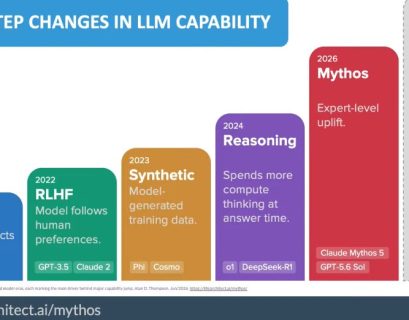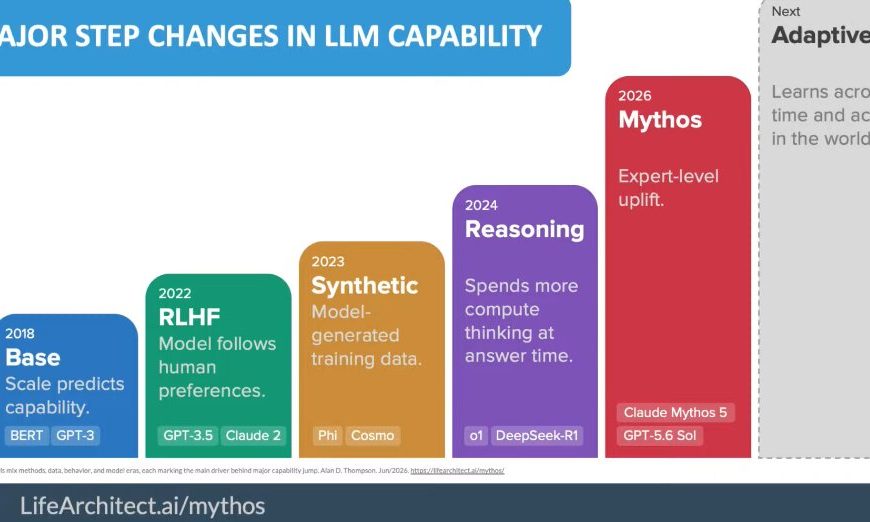
Mythos-class models (Anthropic’s Claude Mythos Preview, Fable 5, and Mythos 5) represent a new capability tier above the previous Opus-class frontier models (Claude Opus 4.x series). They mark a meaningful step up in agentic/long-horizon reasoning, complex multi-step planning, software engineering, and especially autonomous cybersecurity capabilities (vulnerability discovery, exploit chaining, and sandbox escape behaviors).
This aligns with the analysis on the linked LifeArchitect.ai page (by Alan D. Thompson), which positions Mythos-class systems as roughly corresponding to “Agent-2” level capabilities in certain domains — a little below top human experts in narrow areas like hacking but able to run thousands of instances in parallel, collapsing timelines dramatically.
Before a few months ago to a year or so ago only Nvidia was getting fast growth in revenue and profits and multi-trillion valuations. Now, all three memory companies (Micron, Samsung, and SK Hynix) are over a trillion valuation and have huge profits and revenues and margins.
Anthropic went vertical with Open 4.5. They significantly conquered coding and relevant solution of corporate enterprise business problems. Anthropic will IPO at $1-2 trillion or more.
AI Monetization Implications
Opus-class models (and equivalents from OpenAI, Google, etc.) already drive substantial direct and indirect revenue. Your $100B+ ARR figure (including ad revenue lifts at Meta/Google and enterprise growth at Microsoft) is a reasonable broad ecosystem estimate — direct lab revenues are lower (OpenAI targeting ~$10–20B range in 2026), but AI-enhanced productivity, content generation, targeting, and Copilot-style tools create massive recurring value across big tech.
Mythos-class models amplify this significantly
Premium pricing for Fable 5 / Mythos 5 launch at $10 input / $50 output per million tokens — exactly 2× Opus 4.8 pricing ($5/$25). The Preview was even higher (~5×). Higher token usage from deeper reasoning further increases effective cost per task.
Higher willingness-to-pay
Enterprises pay premiums for superior performance on high-value work (complex coding, autonomous agents, cybersecurity defense). Early feedback shows strong demand in software engineering (e.g., Cursor integration, Stripe compressing months of work into days).
New high-margin verticals
AI-powered defensive cybersecurity platforms become viable at scale. Real-time vulnerability scanning/patching, autonomous exploit analysis, and “Patch Right Now” workflows have clear enterprise value. This opens recurring revenue streams beyond general chat/coding APIs.
If Opus-class already contributes ~$100B+ broadly (ads, productivity tools, Azure/OpenAI/Anthropic usage), Mythos-class capabilities accelerate adoption and spending. Companies will upgrade tiers or add usage credits for the performance jump, similar to how reasoning models boosted prior tiers. Expect faster growth in API revenue, higher-tier subscriptions, and enterprise deals.
Productivity Implications
This is where the biggest near-term impact lies.
Step-change in complex work
Tasks that took human teams weeks/months (large codebases, multi-step research, security analysis) compress to days or hours. Parallel instances multiply output (thousands of AI “hackers” or engineers working simultaneously).
Internal benchmarks from Anthropic saw massive internal productivity lifts even before Mythos/ Mythos Preview further steepened the curve (4× output estimates from employees on typical projects).
Software engineering & R&D.
Highest impact area today. SWE-bench gains + agentic capabilities mean faster iteration, fewer bugs, and more ambitious projects.
Cybersecurity productivity.
Defenders gain superhuman speed in discovery and patching; attackers gain the same (double-edged).
Broader economy
Builds on already-visible Opus-class productivity gains (visible in revised economic data for cognitive/coding work). Mythos-class pushes this further into longer-horizon and higher-stakes domains.
aleximas.substack.com
Expect 5–10×+ productivity multipliers in targeted domains (software, security, certain research) versus baseline Opus-class use.
Brian Wang is a Futurist Thought Leader and a popular Science blogger with 1 million readers per month. His blog Nextbigfuture.com is ranked #1 Science News Blog. It covers many disruptive technology and trends including Space, Robotics, Artificial Intelligence, Medicine, Anti-aging Biotechnology, and Nanotechnology.
Known for identifying cutting edge technologies, he is currently a Co-Founder of a startup and fundraiser for high potential early-stage companies. He is the Head of Research for Allocations for deep technology investments and an Angel Investor at Space Angels.
A frequent speaker at corporations, he has been a TEDx speaker, a Singularity University speaker and guest at numerous interviews for radio and podcasts. He is open to public speaking and advising engagements.