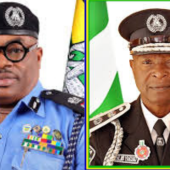
According to a police staff list reviewed by SaharaReporters, DIG Kwazi was scheduled to retire in January 2026 in accordance with existing service regulations.
The tenure of the Deputy Inspector-General of Police in charge of Operations, Bzigu Yakubu Kwazi, has reportedly been extended beyond his official retirement date.
According to a police staff list reviewed by SaharaReporters, DIG Kwazi was scheduled to retire in January 2026 in accordance with existing service regulations.
Similarly, Commissioner of Police Uche Ifeanyi, who heads the National Cybercrime Centre, was due to retire on January 31, 2026.
However, his tenure has also reportedly been extended despite the clearly defined retirement timeline under applicable service rules.
Both developments have raised concerns about compliance with statutory retirement provisions within the Nigeria Police Force.
Under established regulations, officers are required to retire upon reaching the prescribed age or completing the mandatory years of service. Any extension beyond these limits raises questions about transparency, legality, and institutional accountability.
Egbetokun’s Tenure Extension
Inspector-General Kayode Egbetokun also remained in office beyond his retirement age following a tenure extension.
Egbetokun was appointed Inspector-General of Police in October 2023. Normally, under the Police Act 2020, an IGP retires at age 60 or after 35 years of service.
However, in July 2024, the Nigerian Senate passed an amendment to the Police Act. This amendment gave room for the President, with Senate approval, to extend the tenure of an IGP beyond the usual retirement limits.
Following this, President Bola Ahmed Tinubu approved a three-year extension for Egbetokun in September 2024. The Secretary to the Government of the Federation, George Akume, formally handed him the letter confirming this extension.
According to Section 18(8) of the Police Act, 2020, every police officer is required to serve for 35 years or until attaining the age of 60, whichever comes first.
Meanwhile, Section 7(6) of the same Act provides that a person appointed as Inspector-General of Police shall hold office for a term of four years.
Based on these provisions, Egbetokun, who was born on September 4, 1964, attained the age of 60 on September 4, 2024. Under Section 18(8), this would ordinarily require his retirement from service.
However, Section 7(6), which guarantees a four-year tenure for the Inspector-General of Police, created a legal ambiguity between the general retirement rule and the specific tenure provision for the office of the IGP.
According to the National Assembly, to address this inconsistency, it passed the Police Act (Amendment) Bill, 2024, aimed at clarifying the tenure and retirement provisions applicable to the Inspector-General of Police.
This amendment introduces a new subsection, 18(8A), which states: “Notwithstanding the provisions of subsection (8) of this section, any person appointed to the office of Inspector-General of Police shall remain in office until the end of the term stipulated in the letter of appointment in line with the provisions of Section 7(6) of this Act.”
The amendment affirms that the Inspector-General of Police shall serve a four-year tenure, irrespective of the general retirement age or years-of-service requirements.
The Senate justified the amendment by arguing that Nigeria needed continuity in police leadership to tackle rising insecurity, and that frequent changes in IGPs disrupted reforms and long-term policing strategies.
Despite the legal backing from the amendment, the extension quickly became controversial.
Critics argued that the move undermined the spirit of the Police Act and was politically motivated. Many felt that Egbetokun had already reached retirement age and should have stepped down.
The debate grew louder when activist and former presidential candidate, Omoyele Sowore, publicly described Egbetokun as an “illegal IGP” on social media.
Sowore has consistently described the extension as unconstitutional and accused Egbetokun of acting as an enforcer for Nigeria’s corrupt elite.
In response, Egbetokun’s office filed charges against Sowore in early 2025, accusing him of defamation and incitement.